
The global cosmetics industry is entering a decisive new era.
By 2026, beauty brands will no longer be judged by storytelling alone. Performance, regulation, and proven sustainability must exist together: transparently, measurably, and credibly.
Consumers, regulators, and formulators are aligned in one clear direction: beauty that works, lasts, and can be proven.
Below, we explore five key cosmetic trends for 2026 that are reshaping formulation strategies, ingredient sourcing, and how brands define “clean” and “sustainable” beauty.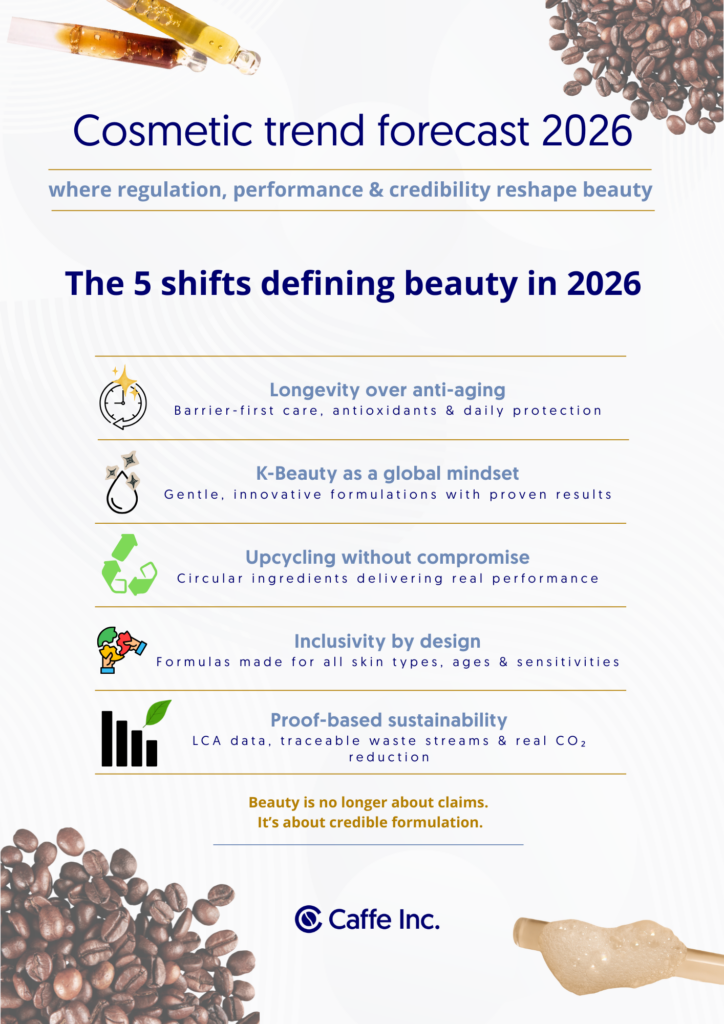
1. Longevity Beauty Replaces Anti-Aging Claims
The language of anti-aging is quietly disappearing.
In its place, longevity-focused skincare is becoming the new standard.
Rather than “reversing time,” longevity beauty supports long-term skin function, resilience, and prevention. This approach aligns closely with both dermatological science and consumer expectations.
Longevity-driven formulations focus on:
- Skin barrier repair (ceramides, lipid complexes)
- Protection against oxidative stress (antioxidants such as coffee oil)
- Daily SPF as a core skincare step, not a final add-on
Longevity is not about promising miracles; it’s about helping skin perform optimally for longer, with consistent, supportive care.
2. K-Beauty Philosophy Goes Global (and Grows Up)
K-Beauty continues to influence global beauty trends. Not because of novelty, but because of formulation philosophy.
At its core, K-Beauty proves that gentleness, innovation, and efficacy can coexist.
By 2026, its impact is visible far beyond Korean brands:
- Prevention over correction
- Barrier-first formulations
- Minimalist, consistent routines
- Respect for skin biology rather than aggressive actives
This mindset reinforces longevity thinking and encourages brands worldwide to design products that support skin health over time, instead of overwhelming it.
3. Upcycling Becomes a Serious Formulation Strategy
Upcycling in cosmetics is evolving really fast.
What once served mainly as brand storytelling is now becoming formulation logic.
In 2026, upcycled ingredients must meet the same standards as conventional ones: performance, scalability, traceability, and regulatory compliance.
What this means in practice:
- Circular ingredients must deliver measurable functionality
- Waste streams must be traceable and consistent
- Sustainability must be technically integrated, not layered on top
Upcycled surfactants are a strong example of this shift: offering high performance cleansing while reducing reliance on virgin raw materials and lowering environmental impact.
Sustainability is no longer a marketing layer, it’s a technical requirement.
4. Inclusivity Becomes Formulation Intelligence
Inclusivity in beauty is expanding beyond shade ranges.
In 2026, inclusive formulation means products that work across:
- Skin types and sensitivities
- Hair textures and scalp conditions
- Ages, genders, and geographies
This drives demand for gentler surfactant systems, adaptable formulas, and multifunctional ingredients designed to perform across diverse needs. By design, not by exception.
True inclusivity is no longer visual.
It is embedded in formulation choices, raw material selection, and safety margins.
5. Regulation Redefines What “Clean Beauty” Means
Regulation is one of the strongest forces shaping cosmetic innovation toward 2026, especially in Europe.
Key regulatory shifts include:
- Expanded EU allergen declaration, accelerating the move toward naturally aromatic ingredients without added fragrance allergens
- Stricter sustainability claim regulation, requiring proof instead of promises
- Increased reliance on LCA data, traceable waste streams, and verified CO₂ reduction
Terms like eco, green, and sustainable are no longer acceptable without evidence.
“Clean beauty” is no longer subjective, it is defined, audited, and regulated.
Credibility Is the New Luxury in Beauty
At Caffe Inc., these shifts are not trends, they are design principles.
Our coffee-based surfactant innovation is built for:
- High formulation performance
- Circular raw material sourcing
- Traceable upcycled waste streams
- Compliance with EU 2026 sustainability and regulatory frameworks
Without relying on assumptions.
Without greenwashing.
With data, scalability, and formulation intelligence at the core.
Looking Ahead to 2026
The future of beauty is not about swapping one ingredient for another.
It’s about rethinking systems, formulation logic, and credibility.
Brands that succeed will be those who combine:
- Scientific performance
- Regulatory readiness
- Proven sustainability
From the grounds up.
Sources: Clean Slate 2026
Read the full Clean Slate 2026 feature via the Online Flipbook