
In today’s world, sustainability is everywhere, in our food, skincare products, in packaging, in marketing campaigns, and across corporate mission statements. But while many companies talk about being “green,” not all of them back it up with real action. This is where the difference between greenwashing and true sustainability becomes clear.
At Caffe Inc., we believe sustainability is not about promises; it’s about measurable impact, environmentally, socially, and economically. Let’s unpack what that means.
What Do We Mean by Environmental Impact?
Environmental impact is simply the effect human activity has on our planet. This includes greenhouse gas emissions, waste generation, biodiversity loss, and the overuse of natural resources.
Measuring this impact matters. Without data, “sustainability” is just a word. Tools like Life Cycle Assessment (LCA) allow companies to track their footprint and identify where they can make real improvements. An LCA ensures full transparency and aligns with international standards
Greenwashing vs. True Sustainability
Greenwashing happens when companies market themselves as environmentally friendly without meaningful evidence. Think of vague eco-labels, “carbon neutral” claims without context, or small surface-level actions that mask larger, harmful practices.
The result? Consumers are misled, and real climate action is delayed.
True sustainability, on the other hand, is rooted in transparency and action. It’s about reducing carbon emissions, rethinking waste, using renewable resources, and showing evidence of impact. Companies that are serious about sustainability go beyond words; they prove their results.
How Caffe Inc. Makes a Real Difference
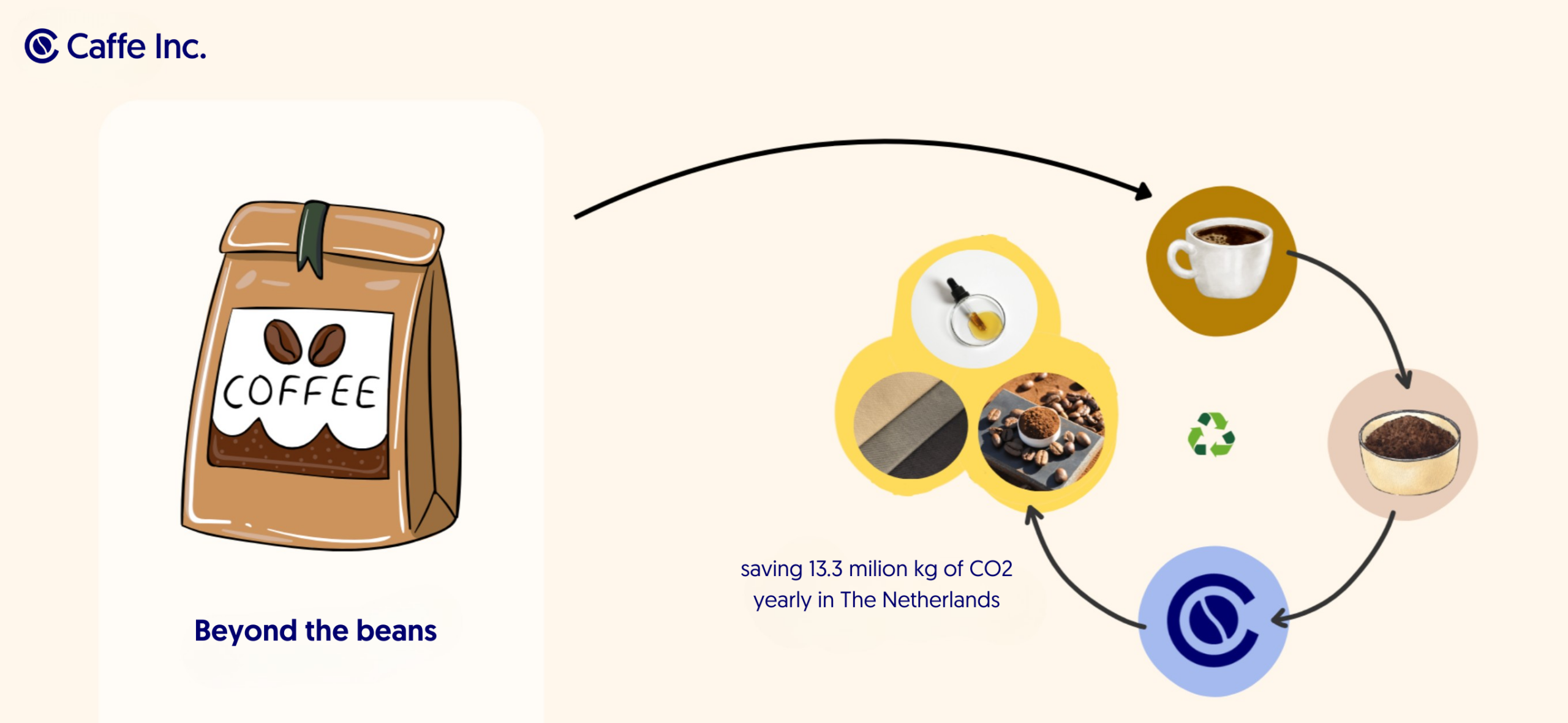
At Caffe Inc., we upcycle one of the world’s most wasted resources, coffee grounds. Did you know that around 80% of the coffee bean is discarded after brewing? We see this not as waste, but as opportunity.
Here’s how we turn waste into value:
- Coffee oil extraction: We stabilize spent coffee grounds and extract natural oil for cosmetic applications, using a non-toxic, energy-efficient method. This process produces five times fewer CO2 emissions compared to anaerobic digestion.
- Coffee blocks: The leftover solids are transformed into sustainable building materials, replacing less eco-friendly alternatives.
- CO2 reduction: Our production process emits 75% less CO2 emissions than conventional disposal methods. If all coffee waste in the Netherlands were processed through Caffe Inc.’s process instead of conventional methods, we could avoid approximately 133 million kg of CO₂ emissions.
The result is a circular system that creates value for both the environment and the economy, proof that waste can be a resource.
The Bigger Picture: Why This Matters Globally
According to the United Nations Environment Programme’s Global Resources Outlook 2024, global resource extraction has tripled in the past 50 years. It now accounts for:
- 55% of global greenhouse gas emissions
- 90% of land-use related biodiversity loss
High-income countries are responsible for a disproportionate share of this burden, using six times more materials per capita than low-income nations. Unless we change course, resource extraction will rise another 60% by 2060, putting our planet at catastrophic risk.
But there is another path. The Sustainability Transition scenario outlined in the report shows that if we adopt circular economy models, improve resource efficiency, and shift toward renewable systems, we can cut emissions by more than 80% while still improving global well-being.
Caffe Inc.’s work with coffee waste is one example of this transition in action, showing that businesses can thrive economically while reducing environmental harm.
Why Proof Matters
In a world where sustainability claims are everywhere, evidence is what makes the difference.
At Caffe Inc., our core value of creating positive impact is ingrained in everything we do, which is why we continuously measure our Life Cycle Assessments (LCA). Our cradle-to-gate LCA ensures full transparency and aligns with international standards (ISO 14040 and ISO 14044). This assessment evaluates the environmental footprint of our ingredients across key lifecycle stages—raw materials, transport, production, and packaging. By analyzing each phase, we identify impact hotspots and continuously optimize for greater sustainability. Through our LCAs, we transparently measure and communicate the environmental gains of our products.
Final Thoughts
The world doesn’t need more green promises, it needs proof of impact.
By transforming spent coffee grounds into valuable resources, Caffe Inc. demonstrates how businesses can go beyond greenwashing to create measurable change for the planet and the economy.
Because sustainability is not just about doing less harm, it’s about doing more good.
From the Grounds up!