
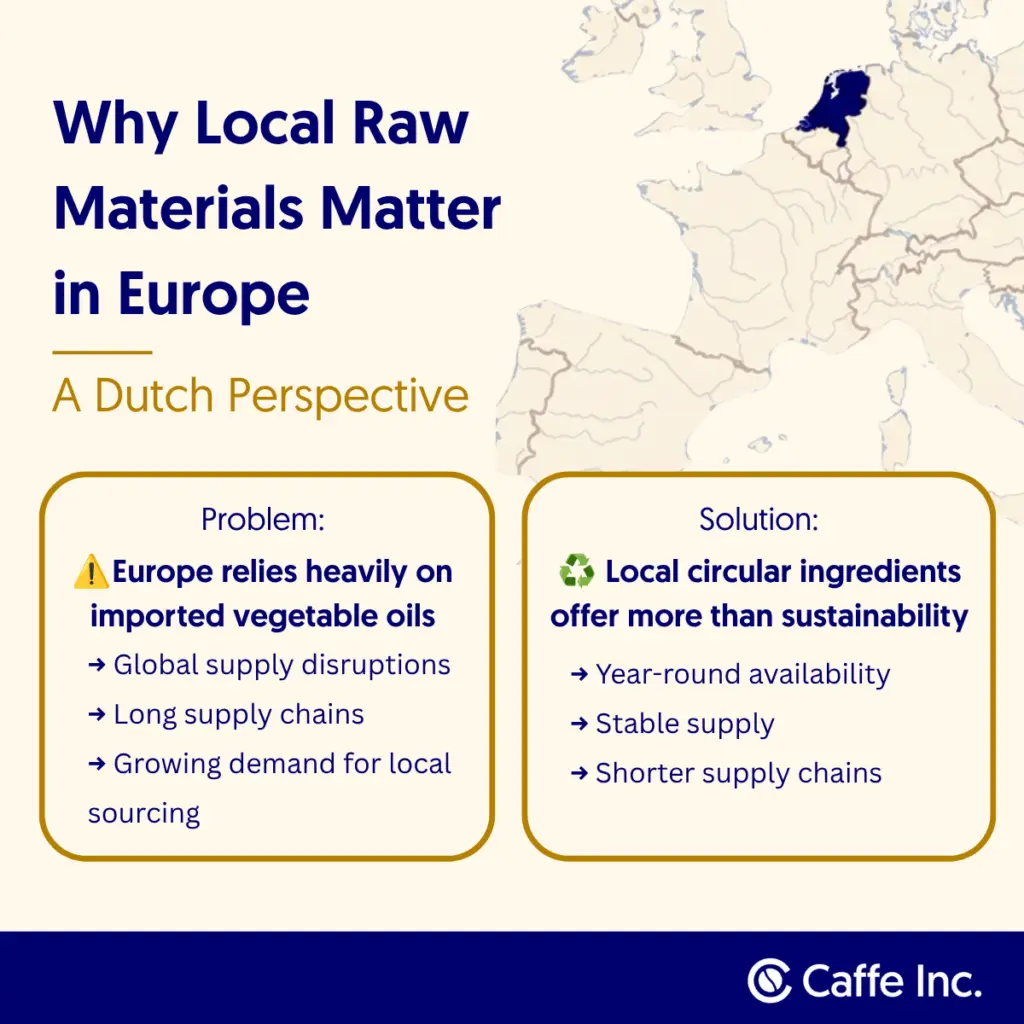
Europe has long relied on imported raw materials such as palm oil, soybean oil and sunflower oil. While global trade has made these ingredients widely available, recent events have shown how vulnerable this dependence can be.
The war in Ukraine disrupted sunflower oil supplies, climate change is affecting harvests worldwide, and new sustainability regulations are reshaping global supply chains. As a result, manufacturers are increasingly looking for locally produced, sustainable and reliable raw materials that offer greater supply security.
Why local sourcing matters
For many industries, including cosmetics, personal care and food, a stable supply of raw materials is becoming just as important as performance and price.
Locally produced ingredients offer several advantages:
-
- Greater supply chain resilience
-
- Improved traceability
-
- Lower transportation emissions
-
- Reduced dependence on global trade disruptions
-
- Better alignment with European sustainability standards
Europe is therefore investing not only in domestic agriculture but also in innovative ways to recover valuable materials from existing local resources.
Waste as a valuable raw material
One of the biggest opportunities lies in using materials that are currently considered waste.
Every day, large volumes of food-processing by-products are generated across Europe. Instead of being discarded, these side streams can be transformed into high-value ingredients for industries such as cosmetics, food and bio-based materials.
Unlike traditional crops, these waste streams already exis, they do not require additional farmland, irrigation or agricultural inputs.
Upcycled coffee: a resilient local resource
Spent coffee grounds are a great example of this approach. Coffee is consumed every day across Europe, creating a continuous and predictable stream of raw material.
By collecting coffee grounds locally and recovering valuable oils and functional ingredients, it is possible to build a reliable European supply chain with several important benefits.
Stable availability
Coffee waste is generated year-round, making supply less dependent on seasonal harvests.
Local production
Shorter supply chains improve traceability and reduce transportation emissions.
More predictable pricing
Unlike many vegetable oils, locally sourced waste streams are less exposed to fluctuations caused by harvest failures, geopolitical tensions or global commodity markets.
A circular solution
Recovering valuable ingredients from existing biomass keeps resources in use for longer and supports Europe’s transition towards a circular economy.
Building more resilient supply chains
Europe is unlikely to become fully self-sufficient in raw materials, nor does it need to. The goal is to create a better balance between global trade and local production.
Circular raw materials can play an important role in that transition by reducing dependence on imported commodities while making better use of resources that are already available within Europe.
At Caffe Inc., we believe waste should be seen as a resource, not a problem. By transforming locally collected spent coffee grounds into high-value ingredients, we help manufacturers build more sustainable, resilient and future-ready supply chains—while giving coffee waste a second life.
References
-
- European Commission. Open Strategic Autonomy.
-
- European Commission. EU Deforestation Regulation (EU) 2023/1115.
-
- FAOSTAT. Crops and Livestock Products Database.
-
- CBS (Statistics Netherlands). International Trade Statistics.
-
- Wageningen University & Research. Circular Agriculture & Biomass Valorisation.