
The problem: When raw materials become unpredictable
As a manufacturer, brand owner and a formulator, there is nothing more annoying than fluctuating prices or raw materials that are suddenly unavailable because of geopolitics or climate change.
Across the cosmetics industry, many ingredients depend on agricultural crops and global supply chains, making their availability and price vulnerable to external disruptions.
One advantage of upcycled ingredients is that they make use of materials that already exist within current value chains, reducing dependence on virgin resources. The coffee market is a clear example of why this matters.
Why are coffee prices fluctuating so much?
Over the past two years, global coffee prices have risen sharply and experienced significant volatility, reaching levels not seen for decades.
These fluctuations are being driven by a combination of factors:
- Climate conditions: Major coffee-producing countries such as Brazil and Vietnam have faced drought, heatwaves and irregular rainfall, while climate change continues to put pressure on coffee-growing regions.
- Logistical disruptions: Geopolitical tensions and disruptions to shipping routes, including the Red Sea, have increased transportation costs and transit times.
- Regulatory pressures: The EU Deforestation Regulation introduces additional traceability and compliance requirements for commodities such as coffee.
- Supply and demand: Growing global consumption combined with constrained supply can place further pressure on prices.
- Financial risk: Investors are now factoring a “climate risk premium into agricultural commodities. RaboResearch notes that markets are proactively driving up prices to prepare for extreme weather like El Niño, meaning buyers pay a penalty for climate unpredictability before shortages even hit.
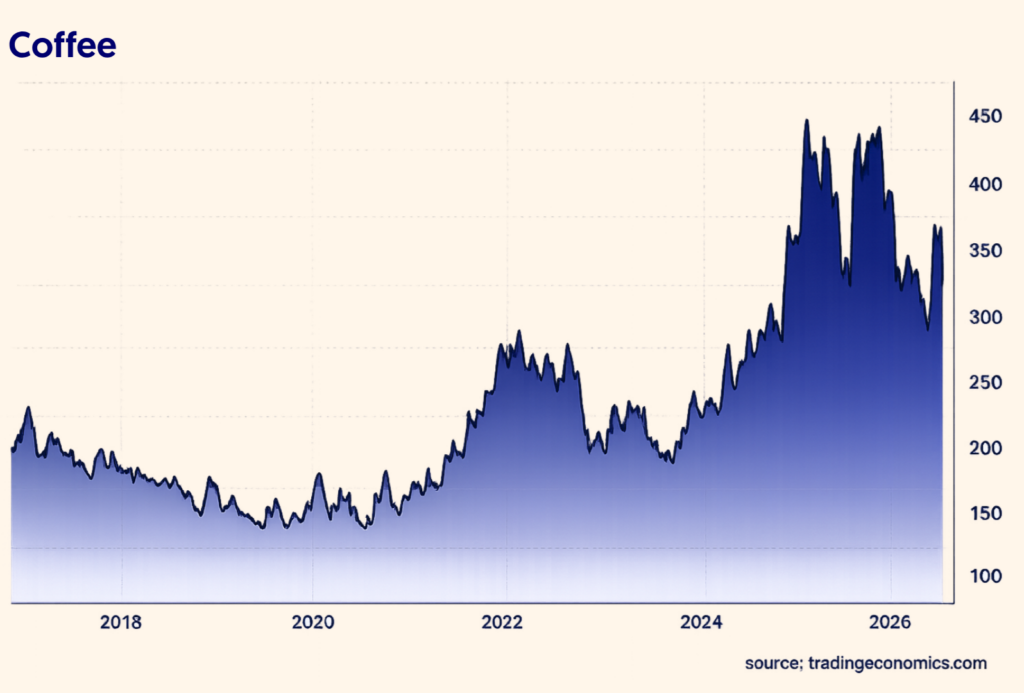
Figure 1: 10-year historical price development of ICE Arabica coffee (USd/lb), showing the sharp increase and volatility in recent years. Source: Trading Economics.
The consequences for manufacturers
When relying on any variable virgin natural ingredient, whether it is cocoa, botanical extracts, or coffee, these market fluctuations directly impact formulation costs.
Virgin coffee oil is a perfect example of this vulnerability. Because it is produced directly from coffee beans, when global bean prices surge unpredictably, the production cost of the virgin oil skyrockets. It is a fundamental risk across all virgin natural cosmetic ingredients.
So, what if the raw material did not need to be grown specifically for your ingredient?
The solution: The upcycled advantage
At Caffe Inc., we use spent coffee grounds left behind by the beverage industry. When coffee is brewed, only around 20% of the bean is extracted into the beverage, leaving approximately 80% as spent coffee grounds.
We collect this material from local partners across the Netherlands and transform it into high-performance ingredients at our Amsterdam production facility.
Because our primary feedstock is spent coffee grounds rather than virgin green coffee beans, we are less directly exposed to fluctuations in the global coffee commodity market. Caffe Inc. currently processes up to 100 tonnes of coffee waste annually, while approximately 250,000 tonnes of spent coffee grounds are generated in the Netherlands each year, providing access to a substantial local feedstock stream.
What this means for our partners
Using a locally sourced by-product provides our partners with greater price stability and a more resilient sourcing model, entirely bypassing the agricultural risks of virgin green coffee beans.
The benefits are environmental too. According to our independent Life Cycle Assessment, our process saves 653 kg of CO₂ per tonne of spent coffee grounds processed and generates 75% fewer CO₂ emissions compared with anaerobic digestion.
To date, Caffe Inc. has upcycled more than 130 tonnes of spent coffee grounds, with our coffee oil used in more than 40 products by more than 30 customers worldwide.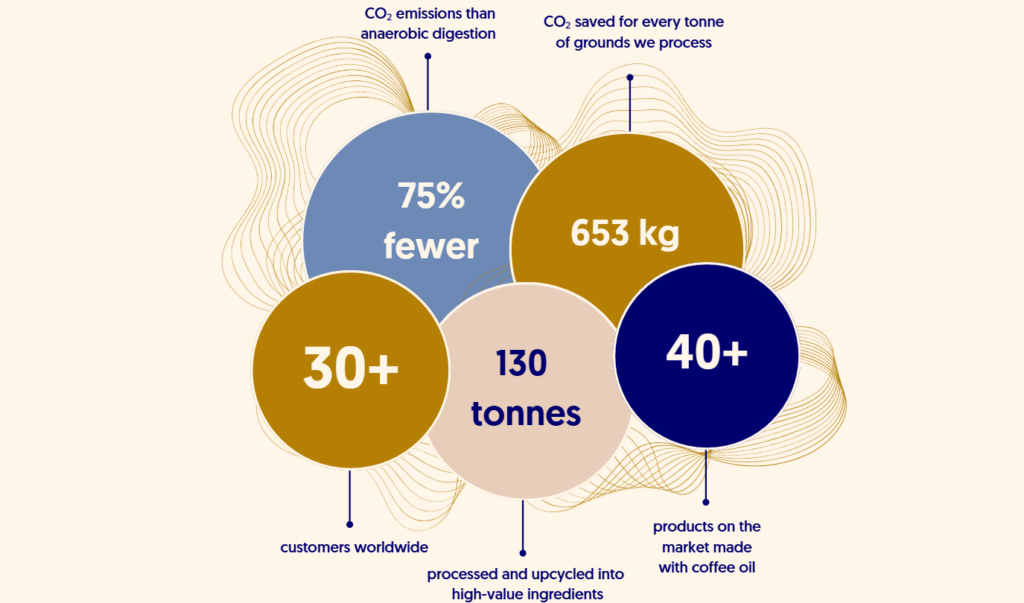
From coffee to a bigger opportunity
Coffee is one example of a broader opportunity for the cosmetics industry. By making better use of existing material streams, upcycling can support more local and resilient supply chains.
At Caffe Inc., we turn these locally available resources into high-performance ingredients with measurable environmental value.
References:
Farm, K., & Farm, K. (2025, 15 mei). Global Coffee Market Analysis and Forecast for the 2025-2026 Crop Year. A New Digital Tasting From KAI Farm. Global Coffee Market Analysis and Forecast for the 2025-2026 Crop Year – A New Digital Tasting From KAI Farm
EUDR coffee: A comprehensive guide — Meridia. (z.d.-b). EUDR coffee: A comprehensive guide — Meridia
Rubinstein, A. (2026, 5 mei). Red Sea Disruption Reshapes Coffee Logistics as Higher Costs Become the New Normal. StoneX US. Red Sea Disruption Reshapes Coffee Logistics as Higher Costs Become the New Normal
Rounton Coffee Roasters. (2026). In Rounton Coffee. Why Are Coffee Prices Rising? | Rounton Coffee
TRADING ECONOMICS. (z.d.). Coffee – price – chart – historical data – news. Coffee – Price – Chart – Historical Data – News